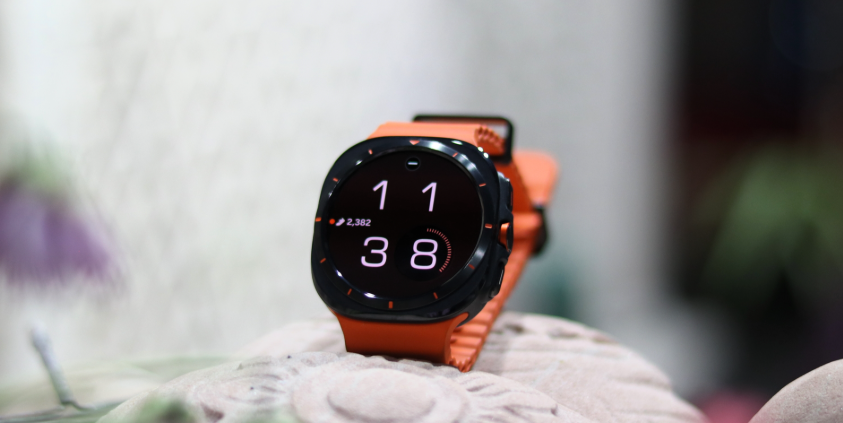
Continuous health tracking has evolved from simple threshold monitoring into deep predictive biometric analytics. Modern wearable platforms continuously sample photoplethysmography (PPG), single-lead electrocardiography (ECG), bioelectrical impedance analysis (BIA), skin and water temperature, and acoustic sleep patterns.
Executing deep neural networks (DNNs) on these high-frequency biometric streams poses a fundamental engineering challenge: compact smartwatch batteries cannot sustain continuous, high-power Neural Processing Unit (NPU) operations.
To resolve these computational and thermal constraints, modern mobile ecosystems employ a distributed NPU execution architecture. Ultra-low-power feature extraction and signal filtering run locally on the 3nm Snapdragon Wear Elite platform of the Galaxy Watch Ultra 2.
When complex multi-parameter health indexing or generative transformer models are required, raw feature arrays are encrypted and offloaded over Bluetooth 6.0 to the Qualcomm Snapdragon 8 Elite Gen 5 NPU inside the Galaxy Fold 8 Ultra.
1. Heterogeneous Edge Computing & Task Partitioning
Running AI models at the mobile edge requires partitioning computational tasks across available hardware nodes based on thermal dissipation limits, battery capacities, and mathematical precision support.
Partitioning Strategy: Watch Ultra 2 vs. Fold 8 Ultra
- Galaxy Watch Ultra 2 Edge Node: Operates within a strict thermal footprint powered by an 800mAh battery. Its Snapdragon Wear Elite processor runs low-power INT8 quantized 1D-Convolutional Neural Networks (1D-CNNs). These lightweight models execute baseline anomaly detection—filtering out motion artifacts from the BioActive sensor array and verifying signal integrity.
- Galaxy Fold 8 Ultra Host Engine: Operates with a 5,000mAh dual-cell Silicon-Carbon battery system and the Snapdragon 8 Elite Gen 5 platform. Its Hexagon NPU processes heavy FP16 transformer models and multi-month health trends without impacting the wearable device’s battery life.
2. On-Device Micro-NPU Pipeline on the Galaxy Watch Ultra 2
The Galaxy Watch Ultra 2 uses its 3nm processor to process raw sensor data locally, reducing the energy costs associated with transmitting uncompressed biometric data streams over wireless radios.
1D-CNN Local Anomaly Gating
Sampling raw single-lead ECG at 500Hz produces 30,000 discrete data points per minute. Transmitting this uncompressed raw stream over Bluetooth continuously would rapidly deplete battery reserves.
Instead, the Galaxy Watch Ultra 2’s local micro-NPU runs an optimized 1D-CNN feature extraction pipeline:
- Windowed Matrix Segmentation: Continuous time-series signals are divided into overlapping 2.5-second time arrays.
- Convolutional Feature Mapping: Three 1D-convolutional layers extract key time-domain characteristics, including peak intervals and ST-segment voltage deviations.
- Gating Logic: If the local model detects a normal sinus rhythm, data is compressed and cached. If an anomaly—such as suspected Atrial Fibrillation (AFib) or sudden oxygen drops during sleep—is detected, the system opens a high-priority L2CAP channel to offload the uncompressed data packet to the host smartphone.
3. Offloaded Transformer Models on the Galaxy Fold 8 Ultra
Once encrypted feature arrays arrive at the Galaxy Fold 8 Ultra, they are fed directly into the main NPU processing pipeline. The Snapdragon 8 Elite Gen 5 platform delivers the math throughput required to run multi-parameter generative transformer models.
Multimodal Health Transformer Execution
Rather than evaluating biometric channels separately, the Fold 8 Ultra’s NPU executes multimodal attention models that cross-analyze multiple metrics simultaneously:
- Sleep Architecture & Respiratory Disturbance Index (RDI): Cross-references wrist actigraphy, continuous blood oxygen saturation, and acoustic ambient signatures to calculate sleep stages and detect sleep apnea occurrences.
- Arterial Stiffness & Vascular Load Inference: Analyzes photoplethysmography (PPG) pulse wave velocity alongside historical bioelectrical impedance (BIA) body composition metrics. The transformer model calculates vascular load and recovery indices without requiring clinical arterial pressure cuffs.
4. Hardware System Specifications Comparison
The distributed AI execution pipeline relies on complementary hardware specifications across both devices:
| Hardware / Subsystem Element | Galaxy Watch Ultra 2 (Wearable Node) | Galaxy Fold 8 Ultra (Host Compute Node) |
| SoC Architecture | Snapdragon Wear Elite (3nm Node) | Snapdragon 8 Elite Gen 5 (3nm Node) |
| NPU Subsystem | Ultra-Low-Power Micro-NPU Core | Multi-Core Qualcomm Hexagon NPU |
| Memory Bandwidth | 2GB LPDDR5 RAM / 64GB Storage | 12GB / 16GB LPDDR5X Ultra RAM |
| Primary Sensors | BioActive (PPG, ECG, BIA), Temp, EN13319 | Ambient Environmental & Acoustic Array |
| Battery System | 800mAh Lithium-Ion Pack | 5,000mAh Dual-Cell Silicon-Carbon Pack |
| Connectivity Protocol | Bluetooth 6.0, Wi-Fi, LTE, Dual-GPS | Bluetooth 6.0, Wi-Fi 7, 5G Sub-6/mmWave |
5. Multi-Canvas UI Rendering & Real-Time Biometric Visualization
Processing complex biometric streams is only half the task; displaying those insights clearly is equally vital. The Galaxy Fold 8 Ultra provides an expanded 8.0-inch Dynamic AMOLED 2X main display (2256 x 2504 resolution).
Canvas Compositing and GPU Acceleration
- Side-by-Side Multi-Metric Viewports: The 8.0-inch main screen allows users to view live high-frequency ECG traces alongside multi-month health trend dashboards.
- Vulkan Graphics Pipeline: Real-time biometric vector graphs are rendered using hardware-accelerated Vulkan APIs. This routes visual compositing directly to the Adreno GPU, keeping the UI smooth at 120Hz without interrupting background NPU inferences.
Technical Summary
The distributed NPU framework connecting the Galaxy Watch Ultra 2 and Galaxy Fold 8 Ultra shows how modern mobile edge AI balances processing power with battery efficiency.
By executing low-power INT8 signal filtering locally on the smartwatch and offloading complex multimodal transformer models to the Snapdragon 8 Elite Gen 5 NPU on the phone, the system delivers continuous health tracking while maintaining power efficiency across both hardware platforms.
