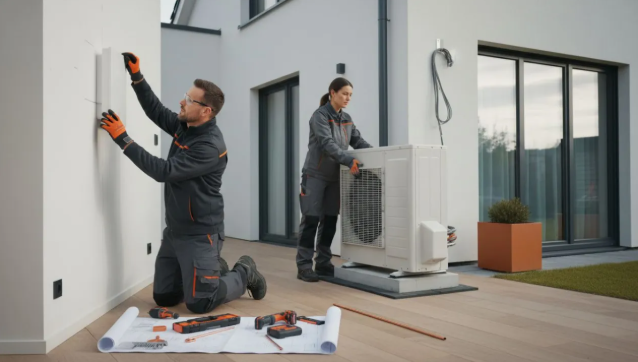
Modern heating and cooling systems often provide flexible installation options, allowing indoor and outdoor units to be positioned according to the layout of a building. However, when these components are separated by a significant distance, careful planning becomes especially important. Refrigerant piping must be correctly sized, properly insulated, securely routed, and compatible with the equipment being installed.
A longer connection can be useful in homes, offices, commercial spaces, workshops, and other buildings where the outdoor condenser cannot be placed immediately beside the indoor unit. Before purchasing materials, installers should understand the equipment requirements, piping dimensions, total route length, elevation differences, and installation conditions.
For projects that require extended routing, a 75 ft HVAC line set can provide a practical option when its specifications match the HVAC equipment and manufacturer’s requirements.
Start With the Equipment Specifications
The first step in planning an extended refrigerant connection is checking the manufacturer’s installation documentation. HVAC systems have specific requirements for pipe diameter, maximum allowable length, vertical separation, refrigerant charge, and connection methods.
Even if a particular tubing assembly has the correct dimensions, it should not automatically be assumed to work with every system. The equipment manufacturer’s specifications should always take priority.
Installers should confirm:
- Required liquid and suction line diameters
- Maximum permitted piping length
- Maximum vertical separation
- Refrigerant type
- Connection requirements
- Additional refrigerant requirements
- Recommended insulation specifications
This preparation can prevent compatibility problems later in the installation.
See also: Fixing Things Instead of Replacing Them
Measure the Actual Route
A common mistake is measuring only the straight-line distance between indoor and outdoor units. Real installations rarely follow a perfectly direct route.
Piping may need to travel around walls, ceilings, corners, structural elements, or other obstacles. Therefore, the actual route should be measured carefully before selecting the required length.
It is useful to account for:
- Horizontal distance
- Vertical distance
- Bends and turns
- Entry and exit points
- Service access
- Routing around obstacles
Adding excessive unused tubing is not always beneficial either. The goal should be to select a suitable length while maintaining a clean and practical installation.
Consider Elevation Differences
The height difference between indoor and outdoor equipment can influence system performance. HVAC manufacturers commonly specify maximum vertical separation limits.
For example, an outdoor unit located on a roof may create a very different installation requirement from one positioned directly outside the building.
Before installation, determine both:
- Total piping length
- Vertical elevation difference
These measurements should then be compared with the manufacturer’s permitted limits.
Protect the Refrigerant Tubing
Copper refrigerant tubing needs protection throughout the installation. Physical damage, excessive bending, moisture exposure, and poor routing can affect long-term reliability.
Tubing should be routed carefully and supported at appropriate intervals. Sharp bends should be avoided because they can restrict flow or damage the tubing.
Where the piping passes through walls or other structures, suitable protection can help reduce abrasion and movement.
Insulation Is an Important Part of the Installation
Proper insulation helps reduce unwanted heat transfer and condensation. Refrigerant lines operating at different temperatures can create moisture-related issues if insulation is missing or incorrectly installed.
Insulation should be:
- Appropriate for the application
- Continuous along the required sections
- Properly sealed at joints
- Protected from physical damage
- Installed according to equipment requirements
Small gaps or poorly sealed sections can reduce the effectiveness of the insulation.
Pay Attention to Connection Quality
Refrigerant connections require precision. Depending on the HVAC system, installers may use flared, brazed, or other manufacturer-approved connections.
Poor connections can create leaks and performance problems. Connections should therefore be made using appropriate tools and installation procedures.
After installation, the system should be tested according to the manufacturer’s recommended procedure before being placed into normal operation.
Keep the Installation Accessible
Long piping routes should not be treated as an excuse to create difficult-to-service installations. Equipment and important connections should remain reasonably accessible for inspection and maintenance.
A neat route can make future servicing easier and reduce the chance of accidental damage.
Where possible, avoid placing piping in locations where it could be crushed, exposed to unnecessary impact, or blocked by future construction.
Think About Future Maintenance
A good HVAC installation considers more than the initial setup. Technicians may need to inspect insulation, connections, supports, and equipment later.
Keeping the installation organized helps identify potential problems more quickly.
Documentation can also be useful. Recording the approximate piping route, equipment locations, and installation details gives future technicians useful information when servicing the system.
When a Longer Connection May Be Useful
Extended refrigerant piping can be particularly useful when the building layout makes a short connection impractical. Examples include:
- Multi-room residential layouts
- Larger commercial spaces
- Rooftop equipment arrangements
- Buildings with restricted outdoor-unit locations
- Installations where noise considerations affect equipment placement
The key is to match the tubing assembly and total length with the HVAC manufacturer’s requirements.
Final Considerations Before Installation
Before beginning an extended piping installation, review the entire project. Confirm equipment compatibility, measure the route, calculate elevation differences, select appropriate insulation, and plan the connection points.
Good preparation can make installation smoother and reduce avoidable problems. The piping should be treated as an important part of the HVAC system rather than simply an accessory connecting two units.
FAQs
1. Why might an HVAC system need a longer piping connection?
A longer connection may be needed when the indoor and outdoor units cannot be installed close together because of building layout, equipment location, noise considerations, or other installation requirements.
2. Does a longer line automatically work with every HVAC system?
No. The permitted length and pipe dimensions depend on the specific equipment. Always check the manufacturer’s installation specifications before purchasing or installing tubing.
3. Why is insulation important around refrigerant piping?
Proper insulation helps control heat transfer and condensation and can contribute to reliable HVAC operation. It should be installed according to the equipment and application requirements.
Conclusion
Long-distance HVAC installations require careful planning and attention to technical details. Measuring the real route, checking equipment specifications, accounting for elevation, protecting the copper tubing, installing proper insulation, and creating quality connections can all contribute to a dependable system.
Rather than choosing tubing based only on length, installers should evaluate the complete installation and ensure every component matches the HVAC manufacturer’s requirements. With proper preparation and professional installation practices, extended refrigerant piping can support flexible equipment placement while maintaining a clean and serviceable system.
